Two Books, Several Startups, and What They Taught Me About Entrepreneurship
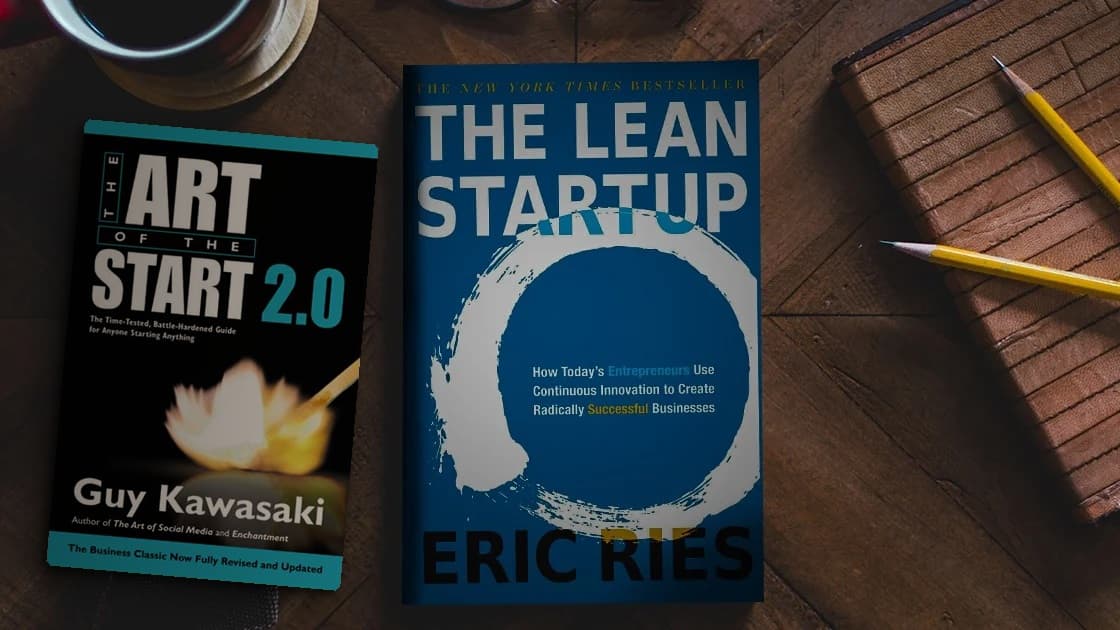
Eric Ries - The Lean Startup
Guy Kawasaki - The Art of the Start 2.0
I really love business books.
To be more accurate, I love re-reading them.
Some books teach you one thing when you read them at 20, then tell you something completely different when you pick them up again at 25. The Lean Startup and The Art of the Start 2.0 are exactly those kinds of books for me.
I bought both of them years ago. They are not books I read once and put back on a shelf. They still sit on my desk, and I still open them from time to time, because as the problems I face change, the lessons I take from the same pages change too.
When I first read them, I thought I was learning about entrepreneurship. It was only after I started building businesses of my own that I began to understand what they were actually trying to tell me.
When I got into business at 17, entrepreneurship looked something like this in my head:
You have an idea.
You build it.
You make a website.
You design a logo.
You open an Instagram account.
Then customers come.
Reality, naturally, turned out to be a little different.
As I worked on different projects, I realized that building a startup is not as simple as having a good idea and making it happen.
Sometimes the problem is the idea.
Sometimes it is execution.
Sometimes it is the market.
Sometimes it is timing.
And sometimes the problem is simply inside your own head.
This is exactly where these two books complement each other.
One teaches you how to think. The other teaches you how to act.
First, Let Us Be Clear: These Are Not the Same
At first glance, The Lean Startup and The Art of the Start 2.0 look like books that belong on the same shelf.
Both are about entrepreneurship. Both talk about startups. Both tell you to go out and build something.
But their approaches are quite different.
Eric Ries looks at a startup almost like an experimental laboratory. Your biggest problem is not how hard you are working. It is whether you are working on the right thing at all.
That is why Ries explains the core activity of a startup through the Build, Measure, Learn loop. You start with a hypothesis, build the smallest thing you can, measure real user behavior, then decide whether to continue or change direction based on what you learn.
The Art of the Start 2.0 is more of an "okay, let us actually begin" kind of book.
Guy Kawasaki goes deeper into the practical side: shaping the idea, positioning, pitching, building a team, bootstrapping, fundraising, partnerships, branding, sales, and convincing people to believe in what you are doing.
In simple terms:
Ries says, "First, make sure this is actually the right thing to do."
Kawasaki says, "If you believe it is, now turn it into action."
Eric Ries: The Lean Startup
If I had to explain this book in one sentence, it would be this:
Do not fall in love with your idea. Test it.
That is the biggest lesson I took from it, because one of the most dangerous traits an entrepreneur can have is enthusiasm.
Enthusiasm is a wonderful thing. It is also dangerous. Once you start loving an idea, you start finding excuses for it.
"Customers will want this."
"People will understand it."
"Once we do a little marketing, sales will come."
"Let me improve the website a bit more."
"Let us finish this feature too."
"Let us launch and see what happens."
Then one day you wake up and realize you spent six months perfectly building something nobody wanted.
I think this is one of Ries's biggest contributions. He breaks the romantic self-deception mechanism that entrepreneurs fall into so easily.
MVP Does Not Mean a Bad Product
One of the most abused terms in the Lean Startup conversation is MVP.
A lot of people think an MVP means the worst possible version of a product. That is not the point.
The goal of an MVP is not to build as little as possible. The goal is to learn as quickly as possible. There is a huge difference between the two.
When I work on a product now, I try to ask myself a brutal question:
"Does this feature actually need to exist, or do I simply enjoy building it?"
It is brutal because for a developer, writing a new feature is often more exciting than getting feedback from users.
Perfecting the design is fun.
Changing the logo is fun.
Adding a new section to the website is fun.
None of these things prove that the product will work.
The Lean Startup taught me that doing more work and making real progress are not the same thing.
Ries describes this through the idea of validated learning. For a startup, progress is not about producing more product. It is about learning which assumptions behind your business model are actually true in the real world.
Why Build, Measure, Learn Is So Powerful
Because it makes you see a startup not as a project but as a loop.
I used to think about it like this:
Idea → Product → Launch → Customer
Now I think about it more like this:
Hypothesis → Small experiment → Real behavior → Result → Next hypothesis
This makes startups much less romantic and much more realistic.
"People want this" is not a fact. It is a hypothesis.
"People will pay for this" is not a fact either. It is a hypothesis.
"This price is reasonable." Hypothesis.
"This landing page will convert better." Hypothesis.
"People will recommend this product to their friends." Hypothesis again.
The job of a startup is to put these hypotheses in front of reality as quickly and as cheaply as possible.
How This Book Changed My Approach
The biggest change is that I no longer believe in the perfect plan the way I used to.
There are simply too many things you do not know at the beginning of a startup, and writing a 30-page business plan does not make those unknowns disappear.
The market can change.
The customer can turn out to be different from what you expected.
The pricing may not work.
Distribution may not work.
The product itself may be wrong.
You may even have misunderstood the problem you set out to solve.
That is why one of the most practical habits Ries gave me is this:
Find your riskiest assumption first. Then test it.
Because as an entrepreneur, your biggest enemy is not failure. It is learning too late.
If you find out you were wrong in three days, that is great news.
If you find out in three months, that is an expensive lesson.
If you find out three years later, you are probably going to call it experience and write a LinkedIn post about it.
Guy Kawasaki: The Art of the Start 2.0
If The Lean Startup taught me what to test, The Art of the Start 2.0 helped me far more with the question of how to actually do it.
Kawasaki's style is very different from Ries's. Ries is systematic and analytical. Kawasaki sounds like a mentor sitting across from you saying, "Yes, it is a good idea. Now stop making excuses and start."
That spirit runs through the whole book, and it is what I like most about it.
The Most Important Thing I Learned From Kawasaki
You do not need permission to start.
There is a strange problem in entrepreneurship. People wait for the business to be ready before they start the business.
The logo needs to be ready.
The website needs to be ready.
There needs to be an investor.
There needs to be a team.
The product needs to be ready.
There needs to be a business plan.
Social media needs to be ready.
Then we can start.
Kawasaki's approach is almost the opposite. Do not wait until you know everything. Start. Then improve.
This was a message I especially needed when I was younger, because in entrepreneurship the problem is often not a lack of information. It is a lack of action.
You read another book.
You watch another video.
You take another course.
You write another business plan.
And you call all of that preparation.
Sometimes the thing you actually need to do is find your first customer.
The Question of Positioning
One of the areas where Kawasaki has been most useful to me is positioning.
Having a good product is not enough. People need to understand what it is and why they need it.
This is a very underrated part of entrepreneurship. If you have to spend an hour explaining your product, the problem is sometimes not the customer. The problem is your positioning.
The more businesses I build, the more I understand this. The better I know my own product, the more I assume the other person knows it too.
But your customer has no obligation to know the history of your product, its technical architecture, or why you made a certain decision at 3 AM. They only need to know one thing:
"How does this solve my problem?"
Kawasaki constantly pushes you toward that kind of simplicity.
What the Two Books Have in Common
Ries and Kawasaki have more in common than I originally assumed. Both strip away the romance around entrepreneurship, both value execution over the idea itself, and both insist on getting out into the real world and talking to real people.
And neither of them treats entrepreneurship as a passive intellectual exercise.
You do not build a business by thinking about it. You build a business by learning through action.
So What Is the Difference?
| The Lean Startup | The Art of the Start 2.0 | |
|---|---|---|
| Main question | What should we build? | How do we start and grow? |
| Focus | Experimentation | Execution |
| Core idea | Validated learning | Action |
| Main mechanism | Build → Measure → Learn | Start → Position → Pitch → Build → Sell |
| Approach | Analytical | Practical and motivating |
| Biggest strength | Better decision making | Taking action |
| What it gave me | A system for thinking | An entrepreneurial instinct |
Ries helps you find the right thing to build. Kawasaki helps you take what you found and bring it into the world.
The Most Interesting Part: Reading Them Together
Over the years I stopped seeing these as two separate books. For me they have become a two-step system.
First, Kawasaki:
What do I want to build?
Who am I building it for?
Why should I build it?
How am I going to explain it?
How am I going to convince people?
Then, Ries:
Which parts of this are actually true?
How can I test them?
What is my riskiest assumption?
What is customer behavior telling me?
Should I continue or change direction?
Then back to Kawasaki. Then back to Ries.
That is how a startup stops being a one-time plan and becomes a continuous learning process.
The Biggest Lesson These Books Taught Me
If you had asked me years ago what I learned from them, I probably would have listed a few terms.
MVP. Pivot. Validated learning. Pitch. Bootstrapping. Positioning. Networking.
Today, something much more important stays with me than those terms.
Accepting that I might be wrong.
That is a serious psychological shift for an entrepreneur. When you love your idea, accepting that it might be wrong is difficult. But that is part of building a business.
Every day you put one of your ideas in front of reality, and reality gives you an answer.
Sometimes it says yes.
Sometimes it says no.
Sometimes it says, in a much less polite way, "Where did you even get this idea?"
A good entrepreneur does not always need to be right. They need to learn quickly.
Which One Should You Read?
If you are starting your first business right now, read both.
I would begin with The Art of the Start 2.0, because it gives you the map and the push to actually start. Then move to The Lean Startup, which teaches you how to test whether what you started is the right thing.
If you are already building a business, the order does not matter much. After a while you stop reading books from beginning to end and start opening the right page when the right problem appears. That is exactly how I use these two.
In the End
Some books give you information. Other books change the way you think. These two belong in the second category for me.
One made me a little more skeptical as an entrepreneur. The other made me a little more courageous.
One told me, "Prove it."
The other told me, "Go. Do it."
That is why they are still sitting on my desk years later.
And perhaps the most important thing I know about building startups today is this:
It does not matter that much how good your idea is. What matters is how quickly you are willing to put it in front of reality.